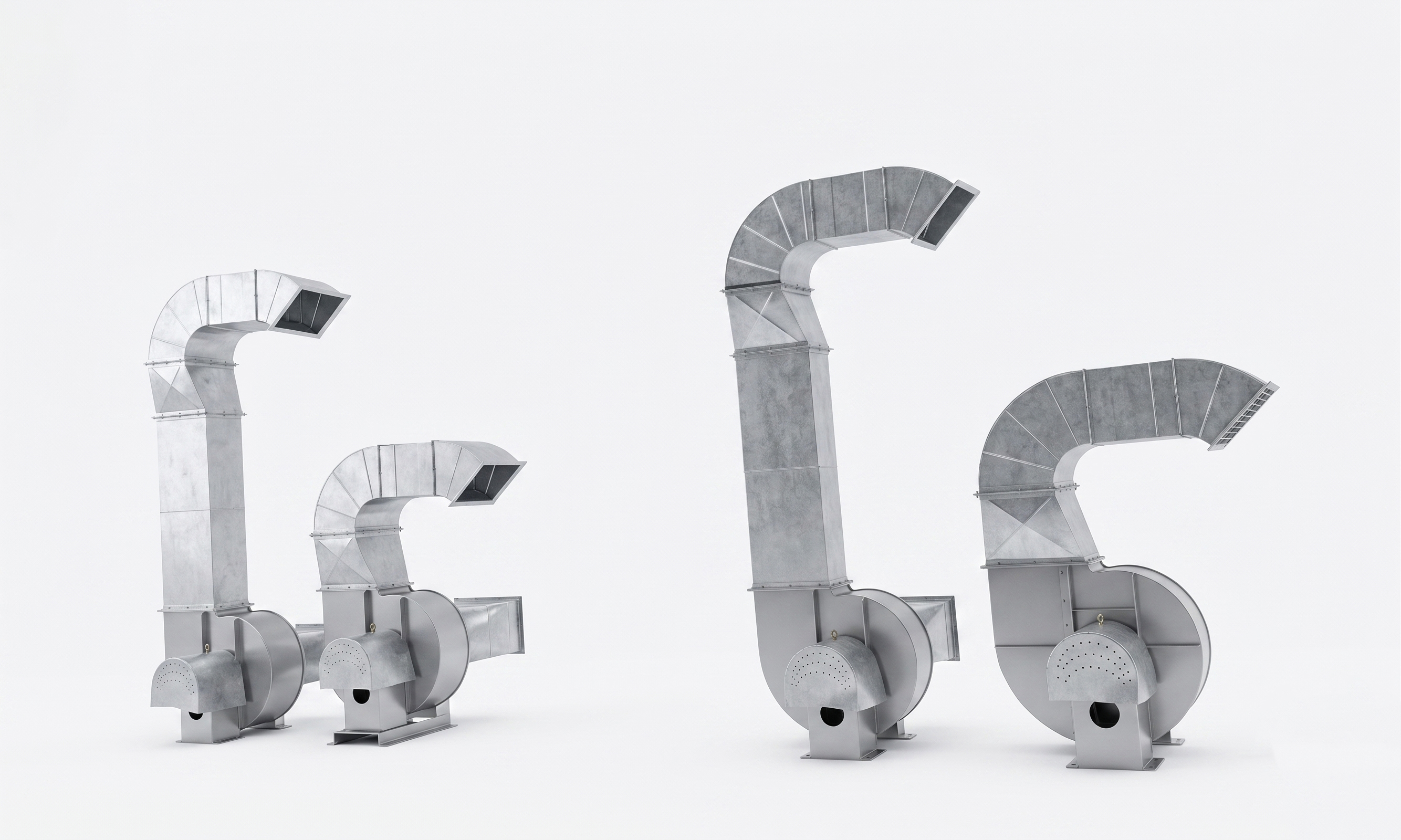
Centrifugal blowers accelerate air radially using an impeller, converting rotational energy into pressure and flow. They are widely used wherever systems must overcome resistance in ductwork, filters, coils, and process equipment.
Inline Centrifugal Blowers
Design: Compact centrifugal blowers designed for direct installation within ductwork.
Key features:
- Space-saving design
- Easier to integrate into duct systems
- Available with various impeller types to suit different pressure and airflow needs
Applications: Duct boosting, exhaust systems in confined spaces, supplementary ventilation.
Key Features of Our Centrifugal Blowers
Moderate to high pressure capability: Centrifugal blowers excel at generating significant static pressure, making them suitable for overcoming resistance in ductwork and systems with filters, coils, and other components.
Versatile airflow range: They can be designed to handle a wide spectrum of airflow rates, from moderate to high volumes, depending on the impeller design and rotational speed.
Stable airflow delivery: Centrifugal blowers typically provide a more stable and consistent airflow compared to axial fans, especially in systems with varying resistance.
Robust construction: Designed for industrial and demanding environments, centrifugal blowers often feature sturdy housings and durable impellers.
Adaptable configurations: Available in various configurations (forward-curved, backward-curved, radial) to optimize performance for specific pressure and airflow requirements.
Relatively lower noise levels (in some designs): Depending on the impeller type and operating speed, some centrifugal blower designs can offer quieter operation compared to certain axial fans at similar pressure levels.
Efficient air handling: Well-designed centrifugal blowers can achieve high levels of energy efficiency for their intended operating range.
Suitable for ducted systems: Their pressure-generating capability makes them ideal for use in ducted ventilation, HVAC, and industrial process systems.
When selecting a centrifugal blower for your application in Bangalore or elsewhere, it is crucial to consider the required airflow rate, static pressure, the nature of the air being moved (clean, dusty, corrosive), noise limitations, and energy efficiency requirements. At Sri Venkateshwara Air System, our experienced team can help you choose the optimal centrifugal blower solution tailored to your specific needs.
Types of Centrifugal Blowers
Centrifugal blowers are primarily classified based on the shape and orientation of their impeller blades.
Forward-Curved Blowers (Squirrel Cage Blowers)
Impeller design: Blades curve forward in the direction of rotation.
Key features: High airflow at relatively low pressure, quiet operation, compact design, generally used for HVAC applications with clean air.
Applications: Air handling units (AHUs), fan coil units (FCUs), ventilation systems in offices, schools, and hospitals.
Backward-Curved Blowers (Radial Tip Blowers)
Impeller design: Blades curve backward away from the direction of rotation.
Key features: High efficiency, stable airflow over a wide operating range, good pressure characteristics, suitable for variable air volume (VAV) systems and handling slightly dirty air.
Applications: Air handling units, industrial ventilation, process air systems, exhaust systems.
Radial Blowers (Paddle Wheel Blowers)
Impeller design: Straight, radial blades resembling paddles.
Key features: High pressure capability, ability to handle abrasive materials and heavily contaminated air streams (dust, fumes, particles), robust construction.
Applications: Industrial process exhaust, material conveying, dust collection systems, high-pressure industrial ventilation.
Airfoil Blowers
Impeller design: Blades with an airfoil (aerodynamic) shape, similar to an airplane wing.
Key features: Highest efficiency among centrifugal blowers, quiet operation, excellent performance in clean air applications requiring moderate to high pressure.
Applications: Large air handling units, critical ventilation systems, applications where energy efficiency and low noise are paramount.
Share your system curve or consultant’s schedule — we can align motor kW, speed control, and bases with your structural and electrical drawings.